Wednesday, March 31, 2010

Refuelling stops


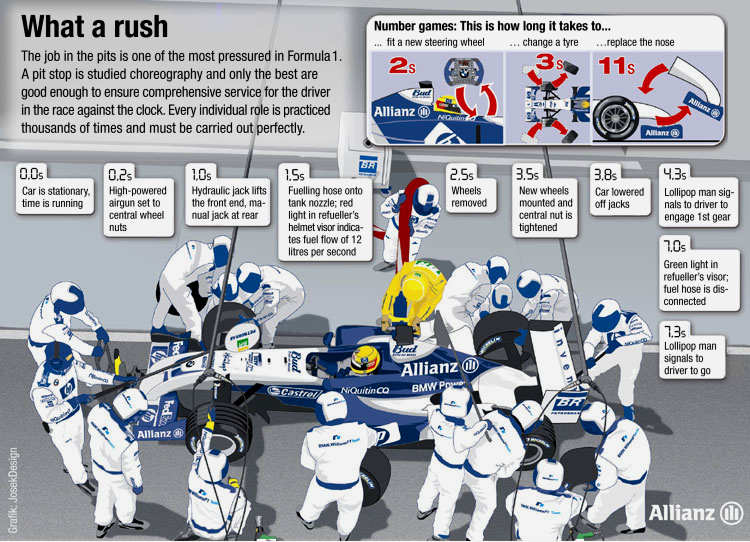
A Formula One car with a big enough fuel tank to do a full Grand Prix distance of 190 miles (305km) would be hopelessly slow. Not only would the car be very heavy at the start of the race, but it would also be aerodynamically inefficient because the fuel tank, which would need a capacity of around 330 litres, would have to be huge. The primary reason for pitting then is to refuel the car. During the fuel stop, teams also routinely check the tyres. As well as having fresh tyres fitted, the driver may take the opportunity of making other changes to the car while he is being refuelled.
The car’s handling may have changed since the car was set up before qualifying the day before. Maybe the car is now understeering too much for the driver’s liking. A quick cure would be to have some extra angle put on the front wing, something that can be accomplished in just a few seconds –usually less than the time taken to refuel.
The driver may have set his car up for the best possible lap time in qualifying, with quite high downforce levels, but he may now be finding that he needs more straight-line speed in order to defend his position in the race. In this case front and rear wing angles might be reduced. Again, this would take less time than is needed to refuel the car.
Depending upon the nature of the circuit and how much lap time penalty there is for a given weight increase, the main question is how many pit stops to make. Traditionally, most circuits have been best suited to two-stop strategies. However, the 2003 regulations stating that no fuel can be added or taken away between qualifying and race mean that three stops are now quite common in order to have the cars as light as possible in qualifying.

Safety and danger in the pits


A highly charged competitive environment compressed into a narrow pit lane where cars share space with crew members and where raw fuel is in close proximity to red hot engines and exhausts makes for a potentially lethal combination.
But while no-one can deny that a Formula One pit lane is a fundamentally unsafe environment, strict safety rules play their part in keeping things under control. These include the following:
  • Pit lane speed limit: The speed limit during pit stops is 60 km/h during practice and qualifying, 80 km/h during the race (60 km/h at Monaco). This limit was introduced in 1994 after a mechanic was injured in the Imola pit lane.
  • Rules against going in reverse: Reversing in the pit lane is prohibited. If a car needs to be moved backwards, the crew must push it.
  • Restriction on numbers of personnel in the pit lane: The crew of the competing cars are only allowed out of their garages and into the pit lane on the lap preceding their car’s pit stop. Other than officials, these are the only people allowed in the pit lane during the race. After the stop, they must return to their garages.
  • Fire-resistant clothing: All pit crew members wear fire-resistant Nomex suits similar to those used by the drivers. These suits can withstand heat of up to 800 degree C for 12 seconds. In addition, the pit crew must wear full-face crash helmets for further protection from fire.
  • Limited fuel pressurisation: Fuel delivery is limited to 12 litres per second, outlawing the high-pressure refuelling used in previous years. This rate of delivery produces a limited pressure that reduces the chances of spillage and fuel nozzle or rig failure compared to the old high pressure systems.
  • Standardised safety valves for rigs, hoses, and fillers: In addition to the dead man’s handle on the fuel rig (this handle ensures that fuel flow stops the moment pressure is released on the handle) the inlet valves and fillers are standardised and designed in such a way as to prevent leakage of inflammable vapours. A two-way system equalises pressure as the fuel is delivered.
Things can still go wrong though, as demonstrated by Ferrari in the 2003 Austrian Grand Prix when flames erupted from the filler of Michael Schumacher’s car during a routine stop. This was later traced to a faulty seal.

Sunday, February 28, 2010

The Pit Crew


Up to 20 pit crew are allowed to service the car during a pit stop. Typically these include the following:
  • Two men at each wheel who work in concert to change the tyres
  • A front jack man who raises the front end of the car
  • A rear jack man who raises the rear of the car and restarts the motor if it stalls
  • A lollipop man, who drops the lollipop in front of the car to signal where it should stop
  • Three refuellers (including one on stand-by) who add the necessary fuel
  • Two fire extinguisher men who stand by in case of a fire
  • Maybe a visor cleaner (some drivers prefer not to have one) who wipes the visor of the driver’s helmet In addition, a team manager usually oversees the whole operation.
That leaves a couple of spare pit crew to do any changes to the car such as wing settings. With the exception of the team manager, the pit crew usually double up as mechanics. No formal qualifications exist that specify who can or can’t be a member of the pit crew, but crew members are invariably fully trained as mechanics. The lollipop man is often the chief mechanic. During a pit stop these folks move in high gear. Each has a job to do and must do it quickly and well.
Between pit stops the pit crew gets to sit down in the pit garage and watch the race on the monitors. They swear when their driver messes up or make rude signs at the screen when he’s not assertive enough in dealing with another driver. They make friendly banter with each other. This is one of the few chances they get over the whole weekend to relax.

Pit Stop Basics


Pit stops are an intrinsic part of modern Formula One. They aren’t compulsory, but dividing the race into stints punctuated by pit stops and thereby having a relatively small amount of fuel on board at any given time is by far the fastest way to get a car through a Grand Prix race distance. This advantage is amplified by the fitting of new tyres during a refuelling stop. There is never any question of whether to have a pit stop or not. The only question is how many.
The pits is the name of the area between the race track and the garages where the team are based for the duration of the race. This area is called the pits because originally, in the dim and dusty past, there was a pit dug out of the track surface where the team personnel would sit and signal their drivers. Originally only this actual pit delineated the working area from the race track. In more modern times, the areas have been separated by a pit wall, and it is now in this area that the selected team members – usually the team principal and two or three race strategists – base themselves during the race. Across the other side of the pit lane the rest of the team – engineers, data loggers, and pit crew – sit in the team garages.

F1 Safety Car


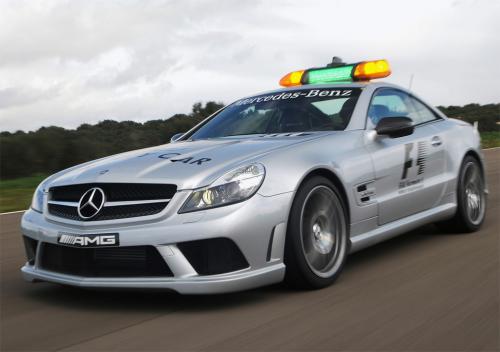
The Safety Car – nowadays a supercharged Mercedes SL piloted by an experienced race driver – neutralises the race in situations where an incident or set of circumstances has exposed competitors or marshals to immediate danger. The Safety Car slows the competing cars to a speed that ensures the safety of those concerned. This could be to protect marshals clearing an accident, or it could be for a sudden extreme downpour that has made the track dangerous. Any time advantage a driver has built up over a rival before the Safety Car came out is nullified as the cars bunch up together. It might give the chasing driver a second bite at a race that had previously been as good as lost. If the Safety Car comes on the track anywhere near your intended pit stop window, it could be very good news. In this situation a driver normally pits immediately. The amount of time he loses to his rivals is obviously far less at Safety Car speeds than it would be if they were still racing flat-out. This can be such a big advantage that you might see a team bring both its cars in together in this situation, even though they’re allowed to work on only one car at a time. The time that the second guy loses while waiting for his teammate to be replenished is far less than he’d lose if he had to do another lap at Safety Car speed.
Another thing to consider is the probable length of the Safety Car period. If the incident looks serious, you can probably bet that the Safety Car will be circulating for a long time. These slow laps still count as race distance, and so your average fuel consumption is going to be significantly lighter than you’d planned for. Depending upon what stage of the race it occurs, a smart strategist works this to his team’s advantage, maybe converting from a two to a one-stop strategy.
Sometimes the implications are quite bizarre. At Malaysia in 2001, Ferrari drivers Michael Schumacher and Rubens Barrichello – who were in first and second places – went off on the second lap as they hit a treacherous mix of oil and heavy rain water. Both rejoined but were now back in 10th and 11th places. New leader David Coulthard spun later on the same lap and pitted immediately. He changed to wet weather tyres and quickly resumed. The Ferrari drivers pitted together, but because they were so far back, they did so in the knowledge that the Safety Car had just been scrambled, which was not the case when Coulthard had pitted. With the field circulating at Safety Car speeds, the Ferrari pit team had longer to decide what tyres to put on their pitted cars – all they had to do was make sure they rejoined before the field lapped them. They reasoned that, with the Safety Car controlling speeds in the wettest conditions, they could afford to fit intermediate tyres. It was a decision that won them the race.

Sunday, January 31, 2010

Understanding race stoppage


If an accident blocks the track, the race is stopped by red flags shown at every marshalling post. If this occurs more than two laps into the race but before 75 per cent of the allocated distance has been completed, the race is restarted 20 minutes later, with the grid formed by the race order on the lap prior to the red flag. The cars must line up on the grid and cannot make for the pits. No fuel can be added to the cars on the grid. Because the results in this instance are an aggregate of the elapsed times of each competitor from the two parts of the race, it’s quite conceivable that strategies will be unaffected. Any advantage carried by one driver over a rival is still maintained in the aggregate result, even if not on track. But consider, say, the McLaren driver who was leading the Williams rival until pitting just before the stoppage. The slower Jordan and Sauber cars directly ahead of him – which might previously have been out of his way – are now holding him up because the restart has bunched them all together. The Williams rival who has not yet pitted is on a clear track and is brought in earlier than planned in order to take advantage of the McLaren’s delay and get out still ahead. Lots of celebration at Williams, glum faces at McLaren. Stoppages that occur after 75 per cent distance can throw the race wide open for different reasons. In this situation, the race is considered over, and the race order on the lap preceding the stoppage becomes the result. This would be very bad news for any driver who had pitted just prior to the stoppage. Who said life was fair?

Great overtaking moves still happen


One of the greatest Formula One overtaking moves of all time happened as recently as 2000, at Spa for the Belgian Grand Prix, proving that it isn’t quite an art lost to Formula One. The race was a flat-out battle of wills between the two men fighting for that year’s World Championship: Michael Schumacher and Mika Hakkinen. Schumacher’s Ferrari had led most of the race but in the late stages was rapidly being caught by Hakkinen’s McLaren.
Schumacher, with more rear wing, was slower up the long hill that follows on from Eau Rouge, perhaps Formula One’s greatest corner. This made him susceptible to attack under braking for the tight right hander, Les Combes, at the end of the uphill straight.
A few laps from the end, Hakkinen got a run on the Ferrari there and sliced his car to the inside. At around 200 mph Schumacher began to edge Hakkinen over towards the grass. The McLaren’s front wing actually touched the rear of the Ferrari as a horrified Hakkinen was forced to lift off. But now he was angry.
On the next lap, the two cars came to lap the BAR of Ricardo Zonta at the very same place as their earlier encounter. Schumacher opted to pass on the left, and in an instant, Hakkinen dived for the right. A startled Zonta thankfully remained on his line as Hakkinen squeezed past and then proceeded to outbrake Schumacher. It was a great gladiatorial victory for the Finn who afterwards was seen to be having a quiet but stern word with Schumacher.